
CCTV design for governments and national infrastructure
To begin with, governments and their technology advisors need CCTV design that survives real scrutiny. So this page sets out what an effective scheme must deliver, from optical performance through to evidential recording. It shows how one Viseum camera unit replaces many conventional cameras.
Every requirement below comes from live deployments in city centres, airports and critical national infrastructure. So your team can lift these clauses straight into a tender document. Meanwhile our engineers will review your existing CCTV design free of charge.

Viseum Surveillance Design Expertise
In fact, Viseum’s surveillance design expertise delivers wide-area coverage from a single unit, close-up evidential images, and a deterrent that offenders cannot pre-empt. You can download our Request For Proposal (RFP) support documentation, or you can contact your Viseum representative for technical A&E specifications for your project.
 Citywide to nationwide RFP (request for proposal) project support. Safe Cities from Viseum The ...
Learn More »
 Viseum’s Command Control Optimised Situational Awareness Obtain the complete ground truth using Command Control ...
Learn More »
Surveillance Design – Overall AI Surveillance Camera Requirements

Of course, a modular hardware configured multiple AI surveillance camera unit must enhance the effectiveness of the surveillance design, to simplify permanent, temporary or rapid AI surveillance camera deployment options. The AI surveillance camera design needs to be suitable for security and situational awareness for complex and challenging environments. For the following environments and applications:
- Populated wide areas.
- Non-populated multiple or single attack intruder environments, in:
- Large wide areas up to 360 degrees, from short range to long range, or,
- Large targeted wide areas, from short range to long range.
A Surveillance Design for surveillance camera solution to:
- Operate as an unmanned standalone camera using Intelligent Moving Camera (IMC) auto-tracking, and,
- Integrate manual AI surveillance camera operator override with:
Coverage for Surveillance Design – per multiple AI surveillance camera
- Where a site needs coverage in multiple directions at the same time but without the need to install multiple PTZ Cameras e.g. a road junction.
- Configure the number of fixed cameras easily to cover up to the area of 4 Olympic Stadiums simultaneously with effective automated line-of-sight video monitoring.
 The Viseum Safe City concept for national security The Safe City concept gives a government ...
Learn More »
- CCTV camera installation for governments and critical sites So every CCTV camera installation we deliver ...
Learn More »
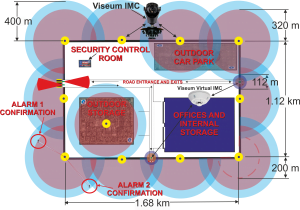
Surveillance Design System Architecture
Certain AI Surveillance Camera solutions have the following coverage issues:
- High specification PTZ Cameras without IMC technology are unsuitable for intermittently manned or standalone video surveillance camera schemes because they:
- Do not cover an entire area simultaneously.
- Independent trials show that pre-set tours miss close-up evidence.
- High specification fixed cameras without IMC technology are unsuitable for standalone video surveillance schemes because the number of high resolution fixed cameras required to cover the same area that each IMC would cover is at least 200.
- High specification auto-tracking speed domes are only suitable for close proximity, non-populated, single intruder environments. However, also encompass complex and lengthy installation and downtime maintenance procedures and the resulting high costs of engineers’ return visits.
- High specification megapixel cameras are unsuitable for covering the specified area because they provide up to only 60m recognition evidence with only a 20-degree field of view in well-lit areas.
- If a high specification speed dome auto-tracking camera or the highly trained operator is already following an event, all other activity outside of the PTZ Camera’s field of view goes unseen.
- It shows that it would require 10 x next best 180-degree megapixel cameras to cover the same area as just 1 x 360-degree Viseum IMC, with associated low light, high bandwidth video transmission, and high capacity storage problems.
AI Surveillance Camera Optical Requirements
- Multiple AI surveillance camera unit to be capable of using a suitably specified PTZ Camera and various high specification fixed contextual view surveillance cameras to suit specified environments and applications.
- One recommended solution for outdoor wide areas with low light sensitivity suitable for automated detection under standard sodium street lighting is:
- Fixed contextual view cameras – Sony Exmor 1/2.8-inch CMOS, 1080p sensor. Fixed lens 4.3 mm 60° horizontal view, Near IR low light sensitivity 0.005 lux (optional full IR).
- Viseum AiPTZ Camera series, and other major brands of PTZ Camera.
- Operators must adjust zoom levels easily in real time or pre-programmed for automated identification and recognition of suspects, and situational awareness.
Redeployable or Relocatable AI Surveillance Camera
- Must give the flexibility to relocate the entire camera system or parts of it easily with plug-and-play assembly and without adding new equipment or communications, to follow crime and disorder hotspots whenever and wherever they appear by:
- Rapidly deploying new camera installations, or,
- Enhancing other existing PTZ Camera installations with IMC modules.
Surveillance Design – Considerations
AI Surveillance Camera Deterrent
- The solution must perform as though it is constantly “manned” with the PTZ Camera moving intelligently, to provide reassurance to communities of constant protection and a visual long-term deterrent to would-be offenders.
- Criminals must see that the system avoids mechanical pre-set tours, so they cannot pre-empt the PTZ Camera’s position.
- In short, criminals must see that fixed contextual view cameras will foil any attempts at diversion/distraction tactics.
Surveillance Design Resilience
- For this reason, a fault in the equipment or communications must not reduce the effectiveness of video surveillance at the central control room or remote observation post.
- Video surveillance must remain operational across the whole area of each camera installation, even if there is a fault on the surveillance network preventing video or telemetry transmission.
- All cameras must continue recording locally.
Data Protection
- In other words, the system must protect the privacy of individuals at all times.
- The system must select targets for close-up recording, automatically triggered by specific location and behaviour.
- The system must keep an audit trail recording when an operator, and when the system itself, is targeting individual people.
Environmental
- Multiple camera unit must be small and light enough to secure onto standard street lighting columns and standard camera poles.
- Camera solution to support environmental considerations by minimising the number of cameras, and quantity of street furniture and cabling installed.
- Where the required area of coverage exceeds what one or two off-the-shelf box cameras can cover, or where size, weight, wind load and cantilever restrictions prevent the use of such cameras, fixed cameras apply. Engineers should then combine them into a practical, aesthetic and cost-effective single camera unit design.
Solutions Supply and Support
No part of the specified solution must infringe any valid technology. Otherwise the buyer risks losing product support, and a recall of infringing goods.
Surveillance Design – Operational Requirements
Auto-tracking Capabilities
- Meanwhile, when no operator controls the camera manually, the system must detect and capture events automatically to close-up evidential quality, no matter what field of view from the camera installation it takes place in.
- So installers must pre-programme the automation with surveillance profile schedules. These schedules must reflect local knowledge of the areas, and the times of day or week when crime usually occurs. Meanwhile the system must continue to monitor areas where other crimes could occur.
- Automated multiple event management.
- The PTZ Camera must switch automatically and accurately between specified numbers of particular events. It must do so when those events occur at the same time in various areas around the camera installation. It must also continue to track all suspects’ locations no matter if they speed up, slow down or change direction.
- The camera to be easily programmed with any number of 1-3 levels of surveillance priorities for close-up evidence from the PTZ Camera, based upon particular activities and locations.
Locally Stored Recordings
The system must offer an option to record video from all cameras digitally and locally to the camera. For example, this local recording must cover a minimum of 30 days. It must use a hard disk specified for 100% 24/7 duty cycle, for primary evidential use and central control room backup storage. All recordings must:
- So be recorded with recognised UK Home Office approved time-stamped, water-marked, bit-for-bit checksumming and encrypted to ensure authentication and data privacy.
- Permit rapid interrogation of the locally stored digital video using real-time IP video streaming.
- Be downloadable locally using digital formats playable using common open-source movie players.
- So operators must be able to download each IMC’s fixed contextual view camera recordings, in any selection from 1 to 6. This must include its PTZ Camera. They must download as a single file. Finally, operators must play them all together, using proprietary digital viewer approved by UK Home Office for court evidence.
- Include a bit-for-bit locally stored evidential recordings seize process for emergencies.
- Have capability for transferring locally recorded key evidence into secure evidence locker local to the camera.
AI Surveillance Camera Maintenance
- Camera solution to encompass automated software-to-software watchdog services with simple hardware module swap out processes, to ensure low maintenance downtimes.
- End-user and their chosen 1st and 2nd line support to receive immediate and direct 3rd line support from manufacturers via secure encrypted high-speed broadband internet connectivity, with dual connection for resilience.
- Option for this connectivity to be securely enabled and disabled under the control of the end user.
Operating Temperatures
- Various models between -40 to +65 degrees Celsius.
- Also, see Viseum Equipment Cooling System.
Surveillance Design – Manual Operation
Mobile AI Surveillance Camera Observation Post
- Ability to manage these camera installations outside of the central control room. For example, during intelligence gathering or emergencies.
- Using wireless 3/4G, WiFi, multichannel COFDM, local LAN access.
- HTTPS TCP/IP secure web browsers to watch all live contextual view cameras, control the PTZ Camera, interrogate recordings local to the camera, schedule surveillance profiles, and prioritise crime hotspots.
- To the above TCP/IP working, all live cameras must also be viewable and recorded remotely in real time.
Surveillance Design – Camera Scheme
Integration AI Surveillance Camera with Command Control
- Camera solution must be compatible with all major brands of central control room equipment using any recognised communications medium. E.g. Fibre, WiFi, COFDM, etc.
- Camera solution’s internal processor must act as a multichannel codec. It must handle controlling, streaming and recording all cameras at the control room. This avoids purchasing additional single, or multichannel, or PTZ Camera data control codecs. So the product costs less, and installers can fit and relocate it more easily.
Operational
- Central control room surveillance operator must be able to take control of the PTZ Camera in a standard way at any time.
- The operator must have the ability to manage each PTZ Camera with the On Screen Display in the normal way but also have the ability to easily modify/schedule IMC surveillance profiles.
- Operator following a live event with the PTZ Camera must also watch and record at the same time. Specifically, they must reach any one of the multiple camera unit contextual view cameras. In this way they see what else is happening in the whole area.
Evidential
- Besides central control room recording, all evidence (both wide-contextual view and PTZ Camera close up) must store locally on the camera. However, the surveillance control room equipment must still access it, using its familiar user interface and digital IP transmission. This means:
- Reducing the need to store contextual evidence centrally, so reducing communication costs, and,
- Providing backup storage as well as control room design.
- A “Smart Search” capability to significantly reduce post-event video interrogation time, i.e. using contextual wide-view camera images meta-tagged to rapidly locate specific areas where close-up evidence is required.
- Once locally stored recordings have been identified as evidence, they can be stored in the central control room, or local evidence locker.
Surveillance Room Design – Command Control Intelligent Video Wall
- Maximising the video wall performance by switching to show only cameras with events of interest.
- Providing automated audio/visual alerts for event detection based on activity and location.
What good CCTV design delivers
- Fewer cameras, because one unit covers what many fixed cameras cannot.
- Lower civil, cabling and installation costs across the whole scheme.
- Close-up evidence that stands up in court, rather than distant wide shots.
- A visible deterrent that offenders cannot predict or pre-empt.
- One CCTV design that scales from a single street to a national programme.
How to start your CCTV design
Firstly, share your site plans and your current camera schedule with our team. Secondly, we model line-of-sight coverage and identify where existing cameras leave gaps. Thirdly, we return a costed CCTV design with a written specification that you can tender.
We benchmark every scheme against recognised guidance on closed-circuit television practice. So your advisors can compare our CCTV design against any competing proposal on equal terms.
Questions governments ask about CCTV design
Does this CCTV design replace our existing cameras? No. Instead, Viseum integrates with all major video management systems, so you keep whatever already works. You can relocate our units whenever priorities change.
How long does a CCTV design take? Typically we return an outline within two weeks. Afterwards, a full CCTV design specification follows once you confirm the sites and the evidence standard you need.
Finally, who signs off the scheme? Your own advisors do. But we supply the calculations and the coverage models, so that sign-off becomes straightforward.
In short, a rigorous CCTV design protects the public, the budget and the evidence chain. Request our CCTV design specification template to begin.