 Viseum AI Surveillance Video Monitoring Software
The Viseum Safe City concept for national security
The Safe City concept gives a government one plan for protecting its people, its roads and its critical assets. First, we study how your cities really work. Then we design surveillance that matches those findings. Your teams deploy proven technology.
Every stage below carries a clear scope, a cost and a measurable security outcome.

One control room for a whole country
An operator works an alert through a guided procedure. Control rooms, city masters and a national centre then link up, with a hot backup at every level.
See Viseum Video Management System
Read the step-by-step description
The view opens on one control room's video wall: nine screens, each a different live alarm scene from the diagrams above (an object found by the Viseum AiRadar, a face confirmed in the camera network, the suspect's car handed from city to city, a person re-identified in the city, a crossing attempt stopped at the border, a drone over a protected site, the plate mismatch sent to the UVSS, the wanted passenger matched in the check bay, and the watch-list alert at the border), with the alerts list beside it. Any screen with an alert is lit in gold, and each alert opens an incident with a guided procedure that the operator follows step by step: the alert is raised and prioritised, an operator accepts it, the right cameras and the map are brought up, the operator verifies it (a false alarm is closed and logged here), a responder is sent with the live view, it is escalated if needed, and it is resolved and logged for review. The view then pulls back: the wall shrinks into its control room on the map, and every other control room in the country comes into view, each drawn as a small, sharp copy of a wall. The network is drawn as a tiered design. Each of three cities has a city master command centre and a backup master on hot standby in a separate area, and its district control rooms report to the master (dashed blue lines are the backup links). Along the land border, the sector controls report to a border master, which also has a backup. Only the masters report to the national command centre, which has its own backup, and they send up only high-risk alarms. Information pulses along the links, each room reporting at its own moment, while people are followed from city to city and each control room they reach lights up in gold. The view then moves into the national command centre, whose wall shows only a few high-risk alarms live, with a status light for every site beneath, and calls up more video on demand (no centre streams every room at once); into one of those screens, which is the first control room's wall; and on into one remote site's live view, before zooming back out to the wall, and the whole sequence runs again without a break. Every zoom takes the same time with the same easing, and every view is held for the same time between zooms.
Global F3 Find, Fix and Follow
One suspect, from a plate read in a city to detention at a border. Each step is found, fixed and followed, and a person confirms before anyone acts.
See Viseum Global F3 Find, Fix and Follow
Read the step-by-step description
A suspect vehicle drives into City A, watched by Viseum 360-degree and fixed cameras, among ordinary traffic. The bar along the top shows the stage: find, fix, follow. The strip along the bottom names where we are (for example City A, Station, Main Street), with the camera or source that has the person and the time; once the view moves in, the inset in the top corner shows the whole city with a gold rectangle for the part in view. Four moments slow down and zoom in: the face captured through the windscreen while the car is held in queuing traffic at a junction, and identified against the watch-list as wanted; the operator confirming the match from the line of look-alikes; the person lost inside a building, every exit watched, and, after changing clothes inside, re-identified on the way out: a card shows the watch-list profile (red jacket) beside what camera 14 sees (grey jacket), and ticks face, build and height, the backpack and the phone data in turn, marks the jacket as changed, and updates the profile; and the switch to a new car, when a drone takes over. Find: the number plate is read on the move; it belongs to a white Nissan Patrol but the car is a black Toyota Camry, so the car is flagged. The crosscheck appears over the bottom right, so the map stays clear. Fix: on foot among people who look alike, the cameras turn to each look-alike in turn and score it as they look (violet circles); the closest scores are listed, and one best match goes to the operator, who confirms it. Follow: each camera hands over to the next with a gold token. Police are told at once, but in a crowded city they follow at a distance and wait for a safe place to stop the suspect, so the cameras keep the suspect in sight for them; the second half shows where that happens. When line of sight is lost, dashed routes run to the cameras the person could reach next; the route to the camera where they reappear turns solid and the others fade. Cameras cannot see through high-rise blocks, only along streets and across open spaces. Each source is shown on the map where its information comes from, and its place on the Global F3 ring lights as it reports: a public post placing them in the area, a database record of past events on this route, a shop's own camera, shared live with the city network under a registered partner programme (as Dubai's Oyoon programme links private-sector cameras) and matched by the suspect's profile, the phone mast whose network data, where lawfully provided, places them inside the building, the vehicle crosscheck of the new car, and the drone. On the right, each source lights as it reports, the match level rises and falls with what is known, the newest finding sits at the top and command control shows which alerts went out. At the end the whole route is drawn in gold and the car, with the drone above it, leaves City A at the edge of the map. The match levels and scores shown are examples. Command control shows how each alert is used: the operator's alarm and the video wall in the control room, the patrol's handheld app (live view, photo and route) and the police radio for the officers on the ground, and the case file, which keeps every image and finding as evidence.
The suspect then drives away. In a slow moment at the city limit, the drone, which flies over City A only, hands the car to the first highway camera with the usual three beats (the drone glows, a gold token passes, the camera glows) and turns back. The same city then pulls out into its place on a simplified map of a real coastline and border, with no real names. Between the highway's cameras the car is unseen, so Global F3 weighs four possibilities, each drawn as a dashed blue route: the car hides in City A, or it heads for City B, the airport or the border crossing. City A's control room watches its parking areas and garages for the hiding case, and the profile, face and plate are sent ahead to the other three. Each possibility is then settled in turn: the plate read at City B rules out hiding in City A; the airport sighting confirms that route; no sighting back in City B rules City B out; and the border crossing is where the suspect is detained. The bars on the right show where the suspect could be, and the clocks show the journey time and the time since they were last seen. Each re-identification is a slow moment: the view slows down and zooms in. On the coastal highway at the edge of City B, a number-plate camera reads the car's plate in moving traffic (the plate is shown masked); staying in City A falls away and the route to City B turns solid. City A's control room then hands the case to City B's: the first glows, a green token travels between them along a green dotted control room link, the second glows, and the label in the corner of the map changes to the control room now in charge. At the airport entrance, where the airport runs live watch-list matching as Gulf airports do, the suspect is re-identified by face and profile against the authorised watch-list and an operator confirms, and police are sent from inside the terminal, but before they reach the entrance the suspect is back in the car and drives away, still followed by the cameras. With no sighting back in City B, the possible routes narrow to the inland road and the case is handed to the border control room. At the checkpoint the face and the plate are matched against the watch-list, an officer confirms, the lane barrier stays closed, and two officers detain the suspect at the booth and lead him away. He never crosses. Because he was heading for the neighbouring country, its police are then told through INTERPOL, in case accomplices or others are waiting for him on their side; nothing is tracked there. Finally the whole journey is drawn, solid gold where a camera saw the suspect and gold dots where it was worked out, with each hand-off marked by a gold diamond, and the panel sums up the sightings, hand-offs and elapsed time. Throughout, the overview in the corner shows where each close-up sits, and the strip along the top names the place. What each source on the Global F3 dial adds: Vehicles reads every plate and finds that this one belongs to another car; Face confirms the person, and an operator checks every match; Social media, checked under lawful authority, places the person on a street from a public post; Knowledge databases (police records) show the route was used before, so the system predicts where they go next; Partner cameras, a shop’s own cameras shared with the police, keep the follow going; Mobile networks, where lawfully provided, confirm the person is inside a building; and Drones follow from above when the person drives away. The match scores, plate digits and journey times shown are examples.
Viseum Video Surveillance Concept for Safe Cities
First 5 Years’ programme + Surveillance Design and pilot installation
The Safe City Concept is an initiative optimising performance for all public services making a city safe. Operators keep control, because human-centred decision support drives every alert. Big data proves invaluable in optimising costs and procedures, making a city safer with each lesson learned.
As a first step, we need to know your likely timescales for your Safe City security project. For example, the more notice we have, the easier it is to arrange suitable members of our own safe city team. Our counter-terrorism, government security advisors and national strategy teams can then support you. They will help you through the processes to strengthen and grow your security assets.
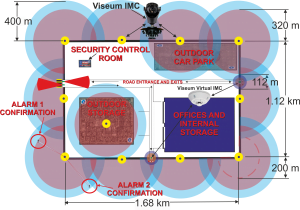
Surveillance Design System Architecture
Viseum UK is managing an increasing number of Safe City projects throughout the world. We fully optimise our Safe City delivery processes. They run in parallel with your city security design. This includes delivery of your initial order, design of your security infrastructure, initial training and integration. Usually, the first installations will deliver security for your city’s highest risk areas (for example, pedestrian crime and/or traffic Public Safety hotspots). Your teams can also complete this training and pilot installation alongside the agreed citywide deployment schedule. The following steps are then necessary to prioritise and manage each Safe City security project:
Safe City Concept Study
Top-level Safe City Concept meetings and analysis are vital to allow us to fully understand the following:
- Your needs and concerns, such as terrorism, traffic management and criminal behaviour.
- Geo-political aspects, societal and economic issues, climate.
- Intelligence databases, the threat and potential incident spectrum, most likely/most dangerous incidents.
- Existing security measures and command and control resources.
- Critical assets and infrastructure (site/city inputs and outputs).
Safe City Technical
Meanwhile, it is crucial to obtain the complete ground truth from a remote site and deploy the best first responder services. For this, you need the AI surveillance camera that reliably produces the most accurate situational awareness.
The Safe City Concept study establishes an operational requirement based on your brief. That work also gives a top-level understanding of what Viseum’s capabilities will allow you to achieve for your security services. This study will establish the following:
- The Safe City Command Control and Communications: These usually comprise strategically positioned Command Control Rooms that monitor several areas, with one master Command Control Centre overseeing all the Command Control Rooms. The result can help identify the size and number of control rooms, display requirements and the associated system/building/power resilience:
- Security growth: How many cameras will be managed now? How many cameras must your control room manage in five years?
- Resilience: Do some or all of the Control Rooms need to be blast-proof? Should they have mirrored data and operational processes fall-back locations? Do other risk reduction factors need a design?
- Security staff: The skillsets for local people as surveillance operators with their local knowledge of the layout and security issues. How many emergencies can they confidently manage? How many routine surveillance cameras could they competently deal with at any given time?
Camera locations, power and communications in the Safe City concept
- The Safe City Camera Locations: Areas that need surveillance cameras, and their mounting and resilience options:
- Camera sensors: Identify the suitable camera and lens at each camera installation. This step usually depends on the available ambient light.
- Coverage: Are cameras required for all main high streets and highway junctions, and/or other specific areas? What buildings require coverage inside?
- Camera poles: Depending on the site layout and environment, some poles will have different designs. These designs also reduce different risks of attack.
- Power: Is the power at each camera installation stable? Or does the power fluctuate for an average number of hours per day? The study also identifies where you need standby backup power.
- Camera Communications: The required video/data transmission systems and their resilience:
- Media type: Can some of the sites have hard-wired transmission or does everything need to be secure wireless?
- Available bandwidth: Some camera installations will need to send more information back to the Command Control Centre. Other camera installations will need to send varied information at random times.
- Regional Requirements: Limitations, restrictions, regulations, etc.
- Commercial Input/Output: Logistics for supply, installation and maintenance.
Safe City Concept Surveillance Design

Safe City Concept Paper
Safe City Detailed Surveillance Design
Once you accept the concept design, we produce an in-depth document. Finally, this will give performance specifications of all equipment and operation of that equipment. This will include configuration detail, schematic drawings, schedules and project deployment programmes.
Complete End-to-End On-time Installation Management
In line with the Smart City initiative, each process uses the fastest and most efficient practical methods to design and deliver each part of the Safe City project, and to benefit from it. This runs from concept design through to full in-life operation. Our trusted single-source asset mapping system achieves this securely. It can use secure GPS (Global Positioning System) RFID tags embedded in all cameras and security devices. This allows you to manage processes securely in real-time, automatically and with your complete control and visibility.
Project Manager
Your Viseum Safe City Project Manager is a seasoned security professional with a wealth of multi-disciplinary experience. Our team gives your needs the very highest priority. This manager can also have day-to-day oversight of the project. This runs from pre-contract negotiations to delivery, installation, integration into a Command Control (including complete Control Room design and build where appropriate) and handover of the system. Our specialists are the first point of contact for all enquiries. They will also provide you with regular reports on progress on the contract.
Safe City Operational Security – Scope, goals and objectives – Short, medium and long term
The Viseum team is responsible for the best fit-for-purpose technology and takes responsibility for helping you deliver the best security success. First, we need to know what security effect you want to achieve in the short term. We also need to know what security effect you want to have achieved over the first 5 years, and then 10 years. Viseum will then develop processes and a growth plan to help you deliver this.
These development processes relate to how and when you interact with your existing security infrastructure. That is your security guards, police, emergency services, army, etc. They also relate to how you interact with your public. Viseum UK will help select and train your security staff. They will help develop appropriate processes, policies and strategies for using the video surveillance. This covers preventive, reactive and post-incident investigation work. Your Viseum Project Manager focuses exclusively on delivering this success. It includes the successful integration of your existing security and surveillance solution processes and policies.
Safe City Support and Ongoing Training Services
Viseum UK is well known for introducing advanced technologies as trusted plug-and-play solutions. A significant part of this is how we deliver support using Viseum Remote Managed Support Service. That service uses secure remote access that you can enable and disable as and when you may need help. Our dedicated IT security specialists fully support it, all of whom have extensive experience in the integration of IP security, data networking and end-to-end video surveillance processes. This enables the Viseum Support Team to provide first-hand interactive training and support. This helps Viseum’s Centre of Excellence see what the end-users see, and listen to their local knowledge. Your operators then train the intelligent learning capabilities of each Viseum IMC Camera. The result helps each camera operate automatically as needed to solve and stamp out crimes, and optimise traffic management.
Video Surveillance Concept Documents:
- Safe City: Report on high risks.
- A Safe City Pilot/POC.
- Viseum Technology and Support Strengths.
- The Viseum team Site Survey.
- Safe City: Phased Technology Introduction Programme.
- Benefits of Safe City: Training Course Number 1.
- Benefits of Safe City: Training Course Number 2.
- Our Safe City Delivery Process Presentation.
- Safe City Operational Surveillance Training.
- Command Control Operations.
Comparing Safe City options
Technology advisors use this Safe City concept to compare options on equal terms. A city’s routine and emergency security services will constantly evolve. This will help you discover the capabilities, benefits and operational processes of Viseum solutions.
Explore Viseum
Viseum Safe Cities PSIM
What happens after you contact Viseum
A specialist reads your project questionnaire for a commercial review and checks it against projects we have already delivered.
We arrange a live demonstration, either online from your own desk or on your site with a Rapid Deployment trailer.