 Viseum AI Surveillance Video Monitoring Software

One Viseum camera does the work of 6 constantly manned cameras, a Metropolitan Police surveillance officer reported. Read the report
Counter Drone System from Viseum
Viseum AiRadar is a counter drone system that finds, fixes and follows every drone and its pilot around a protected site, by day and by night. It protects government facilities, airports, prisons, energy sites and major events; for military bases, see Military Drone Defence. “Military-grade security with outstanding performance.” (Senior Officer RAF).
Counter drone: find, fix, follow and defeat
Several units locate a drone and its pilot together. Radar alone never locates by triangulation, and the law decides who may take action.
Read the step-by-step description
This follows the idea in Viseum's counter-drone brochure, one unit's zones first and then several units locating a drone's pilot together, brought up to date. It opens straight on one protected site. One unit at a protected site: its Viseum AiRadar locates a drone inside the gold ring, and its radio receivers hear a drone's signal further out but give only a direction, drawn as a narrow wedge that widens with distance. A drone takes off from a palm grove far from the site. Each unit's radio reach is drawn in blue and its AiRadar zone, where the AiRadar alone locates and tracks a drone, as a dashed gold ring; radars never combine to locate anything. Find: unit 1 hears the drone and then the pilot's controller, a direction to each but no position. Fix: two more units are networked, one on the far side of the site and one on a vehicle. Where two wedges overlap, the pilot can be; at a narrow angle that area is long, so the vehicle drives out to see the pilot from a wider angle, and with all three units within radio reach of the pilot, three directions shrink the area to a small patch. The units then compare, on one shared GPS clock, when the signal reached each of them, and the timing pins the pilot down far beyond any radar. The system also listens for Remote ID, which on broadcasting drones gives away the pilot's position; this drone broadcasts none, so it is treated as unknown. Follow: inside unit 1's inner zone the AiRadar tracks it and the thermal and optical camera, guided by the AiRadar, shows a quadcopter with a payload; radio, AiRadar and camera become one track, and the AiRadar's AI marks it a drone, not a bird. A person confirms the threat. Defeat: police, under lawful authority, take over the drone's radio link and land it in a safe place, while police drive to the fix and search the last stretch on foot with a hand-held finder, then detain the pilot. A second drone is controlled through a fibre-optic cable, drawn with light pulses travelling along it from its launch point: it gives the radio receivers nothing to hear, locate or take over, so the AiRadar and the thermal camera find it, the camera showing a quadcopter with a payload. A person confirms the threat; police launch an interceptor drone, which the AiRadar track guides out until its own camera locks on, and it catches the drone in a net. The drone is lowered into a cleared area and a safety area is closed around it: nobody goes in except bomb disposal, because its payload is still live until they make it safe. Unknown drones are drawn gold, hostile drones red, the interceptor blue, and a drone that has been dealt with grey. Both flight paths, the take-off point, the pilot's position and the video are kept for the police. Last, a swarm of five drones flies towards the site: radio and AiRadar pick it up, their control signals come from one place and crossed directions fix the pilot, every drone is tracked, the site locks down with people indoors and gates closed, and police detain the pilot; where the swarm's radio link allows, police under lawful authority take it over and land all five drones in a safe place, where they are seized; drones flying pre-set routes with no live link are caught by interceptor nets instead (a hostile pilot can switch off a drone's return-home setting, so it is not relied on). In the UK only the police or the military, under lawful authority, may take over, jam or bring down a drone; the site itself detects and reports. No distances are shown.
This anti-drone system, also called counter-UAS, joins three sensors into one picture. A 3D dual radar has a typical range of 25 km (confirmed by site survey). Radio receivers hear each drone and its controller, and thermal cameras show what each drone is. It sees through smoke, dust, cloud and fog, and it locates the pilot, so police or the military can act under lawful authority. Designed by Viseum. Made in Great Britain under licence. Installed by Certified Partners.
Technology War
Developing counter-drone systems is a constant, ongoing high-tech war. Each drone or UAV system uses different tactics and strategies depending on many types of drone technology. Distances, terrain, weather, operational timescales, the assets being protected and many other variables also differ. Viseum Red Teaming takes all of this into account to anticipate each possible attack, so that the Viseum Blue Team can develop the best protection.
Viseum AiRadar – Anti-Drone Counter Drone Dual Radar
The most successful counter-drone system has multiple anti-drone radars using 3D precision radar modelling and artificial intelligence. This counter-drone system provides the highest technical advantage for defending against attacks from insurgents using drones for their reconnaissance. This counter-drone system helps prevent attacks from land, air and sea at the same time. It detects drones and drone operators through smoke, dust, clouds and fog, providing the GPS coordinates of the drone and its operator.
360° air, ground and sea Counter Drone System AiRadar
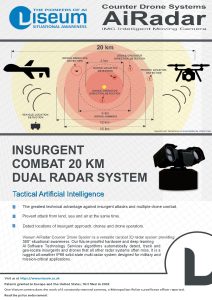
Viseum AiRadar gives up to 120° vertical coverage. This detects ground, sea and aerial targets simultaneously. Viseum AiRadar is a true solid-state radar with no moving parts. It is more reliable than standard antenna radars that rely on moving parts.
Drone operator location detection
Overlapping multiple radars will also detect drone operator locations with greater accuracy. A typical deployment places 3 Viseum AiRadar systems 25 km apart in a triangle, covering an area of around 4,000 km², with the central 1,400 km² watched by at least two radars at once for continuous tracking. When the alarm is raised from a remote location, Viseum AiRadars are rapidly deployed on vehicles to protect many hundreds of remote sites from attack from land, air and sea.
Multiple drone attack
Multiple drone targets are handled well using the Counter Drone System’s artificial intelligence and its 3D precision radar modelling. This means it can detect, track and identify several drones at the same time, so the authorised response can be directed at each one.

Insurgent combat radar
The Viseum AiRadar counter drone system is the greatest technical advantage against insurgent attack and multiple drone combat. The Viseum 3D dual radar counter drone system detects at a range of typically 25 km, confirmed by site survey. This means it can detect and counter multiple drone attacks at the same time.
Ignore birds and confirm drones

This optimises operational time to counter the threat from hostile drones. Viseum’s anti-drone system’s AI and 3D modelling are also used to identify the difference between birds and drones.
Counter Drone System – Training and Support

Insurgents change their strategies and innovate. Viseum’s strength is remaining ahead of insurgents by innovating better with the customer. We provide dedicated engineers for ongoing counter drone systems design, using our high-tech anti-drone radar team and highly expert innovators. This counter-drone system’s training and support services are growing an extensive database of drone types and models. This includes anti-drone radar strategies, techniques and tactics. Viseum exports in line with UK export control and sanctions law and applies for an export licence wherever one is required.
Facial Recognition Drone
Viseum’s outdoor Video Analytics Software has a clear lead in face recognition software. It is the only face recognition software to detect faces at distance from a 360 camera that follows each person automatically. Viseum leads all competition in drone face recognition.

 Viseum face recognition software optimises any network of cameras: it automatically detects and recognises faces from short range to long range.
Learn More »
 Social media investigations software from Viseum matches watchlist faces across sources with ethical AI.
Learn More »
Downloads
Anti drone detection questions
How does anti drone detection work?
Viseum AiRadar detects the drone, thermal and optical cameras confirm it, and the system follows it and locates the pilot, so the response team acts on one confirmed picture.
Who uses it?
Airports, prisons, critical infrastructure, events and military sites.
Why Viseum?
One Viseum camera does the work of 6 constantly manned cameras, a Metropolitan Police surveillance officer reported.
More in Featured Projects
 Military Drone Defence
 Safe Cities
 Missile Detection System
 Border security cameras
 Safe City
- Counter Drone System
 Traffic Enforcement Camera
 Airport Surveillance
 Critical infrastructure security cameras
 Construction Site Security Cameras
 Gated Community Security Systems
 Riot Police and Riot Control Cameras
- See everything in Featured Projects
Radar detection 2004

More videos
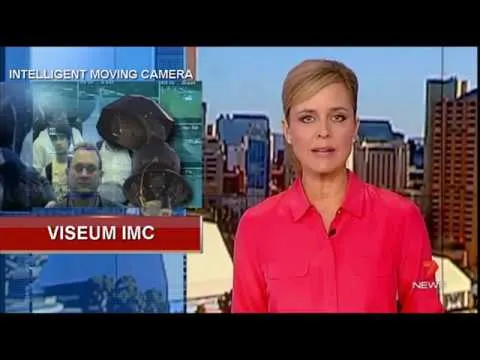 Viseum AI camera on TV
 One UK market example
What happens after you contact Viseum
A specialist reads your project questionnaire for a commercial review and checks it against projects we have already delivered.
We arrange a live demonstration, either online from your own desk or on your site with a Rapid Deployment trailer.