 Viseum AI Surveillance Video Monitoring Software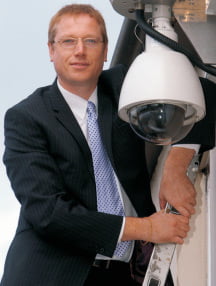
Engineer. Inventor. President of the Viseum UK Group
He was told that cameras moving themselves to a crime could not be built, so he built them.
He used them to pioneer one of the world’s first AI markets.
Where it started
From wireless networks to a camera that thinks
In 1997, he travelled internationally to explore new ventures through WQS, the business he created, and cutting-edge wireless technology caught his attention. On his return to the UK in 2000, he designed and built one of the world’s first wireless access points to carry its own router, firewall, gateway, VPN and data storage in a single unit, the All-in-one box. His customers then wanted to share cameras as part of their neighbourhood watch, because town centre CCTV had pushed crime out into the suburbs, where nobody was watching: the job of a CCTV camera had only just begun. In 2003, supported by the head of the CCTV User Group, he met one of the UK’s largest police forces and asked one question: if I build it, will you use it? The answer was yes. The UK Department of Trade and Industry first told him that a camera that moves itself to a crime as it takes place was impossible; after he demonstrated it, the Department offered him its largest financial SMART award, and he founded Viseum UK. He built the camera, tested it with UK police forces, and their deployments developed it further. One force wrote of the company’s continuous improvement programme:
“Their vision in wanting to improve an already great product and service is astonishing.”
A UK police force, in writing
Initial results
What the cameras caught
The cameras watch whole areas, decide for themselves what matters, and move in for the close-up. The first deployments showed what that means on the street, and councils put the serious crimes they caught on record.
A murder investigation
Detectives came to Viseum’s office to take the video from every camera within a mile of a murder scene. They found the camera had captured close-up detail of the victim whilst he was leading a drug deal, moments before he was killed.
The drunk driver who came back
In the dead of night, the camera recorded close-up detail of a drunk driver crashing his car, running off, and returning moments later to collect his belongings.
A gang stealing motorbikes
In the early hours of the morning, the camera recorded a truck stopping next to an expensive motorbike, with a gang then hoisting it into the back and driving off, all within just a few minutes.
Call-outs that stopped
“We all have those areas where we respond two or three times a day and sometimes more, but not anymore.”
A community police officer, at a police training event.
Serious crimes on record
Borough councils put the cameras on their housing estates and compared them, like for like, with their own manned CCTV. These are among the serious crimes the cameras captured.
Source: Brian Sims, Security Management Today
What one of the UK’s largest police forces found about the coverage of one Viseum camera is published on this site.
Mobile phone network
The connection a police force could not make
One of the UK’s largest police forces had security policies that made it impossible for cameras to use its mobile phone network. Stuart set up engineering teams in several countries to work the same problem at the same time.
On the live network
Protocol analysers ran on the force’s live mobile network, not in a laboratory.
Faults as they appeared
Each team diagnosed faults the moment they showed, in several countries at once.
Fixed as they went
The fix was developed during the test itself, until the cameras connected.
It was never just cameras. It is complete solutions. When the obstacle was a police force’s own network rather than the camera, he engineered the network fix as well.
Then came public body endorsements
Tested by councils. Endorsed in print.
Peter Fry, director of the CCTV User Group, borough councils and the national press put what they saw on the record.
“I was personally very impressed with the Viseum technology that has now overcome virtually all of these constraints and provides a well engineered system at a cost that makes it a viable solution for both smaller neighbourhood watch groups and groups of retailers.”
Peter Fry, director of the CCTV User Group, writing after a Viseum demonstration. CCTV Image, which put the camera on its front cover.
“The trials demonstrated in their first year that the Viseum system caught crucial evidence on all reported incidents and also on several unreported ones, but that the manned CCTV infrastructure did not record any evidence.”
Borough councils’ like-for-like trials, reported by Brian Sims in Security Management Today. The councils wired the cameras into their CCTV control rooms to compare them against their camera operators.
“Unlike a human operator, the camera can watch more than one event at a time without suffering from information overload or loss of concentration.”
The borough council officer who assessed the camera throughout its trial. Police Review and Professional Security.
“The camera picks up on unusual movement, zooms in on someone and gathers evidence from a face and clothing, acting as a 24-hour operator without someone having to be there.”
The council’s head of CCTV. The Sunday Times and the Daily Mail.
Half the cost of a staffed camera: “the potential saving of 50 per cent a year, per camera.”
The council’s cost comparison. Professional Security, “A real world test for camera”.
“A breakthrough in surveillance technology … has secured astonishing reductions in crime during police trials.”
UKWatch, “Smart CCTV ‘thinking’ to tackle terrorism”, which named him as the technology’s inventor.
The newspapers and trade journals
Every page below opens the full article.
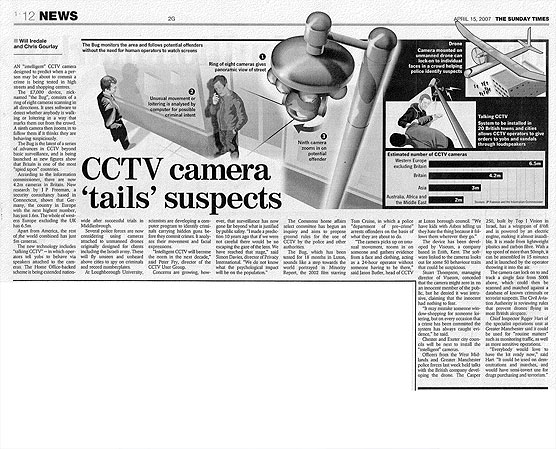 The Sunday Times15 April 2007, page 12“CCTV camera ‘tails’ suspects”
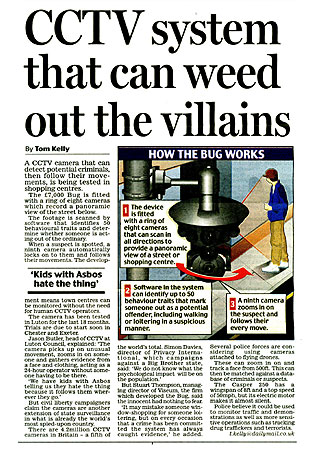 Daily Mail2007“CCTV system that can weed out the villains”
 CCTV ImageWinter 2004, cover story“CCTV goes bug-eyed”
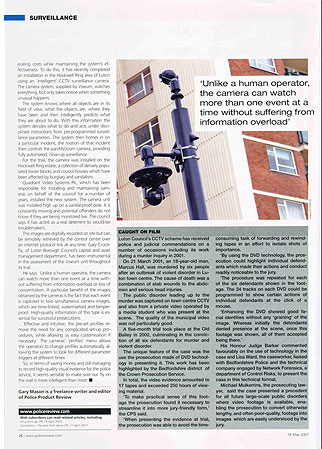 Police Review18 May 2007“Fly on the wall”
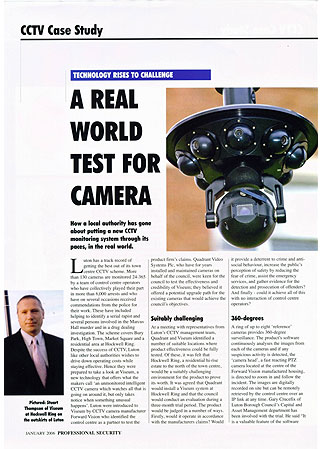 Professional SecurityJanuary 2006“A real world test for camera”
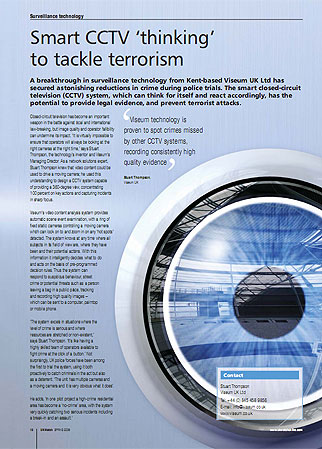 UKWatchSpring 2006“Smart CCTV ‘thinking’ to tackle terrorism”
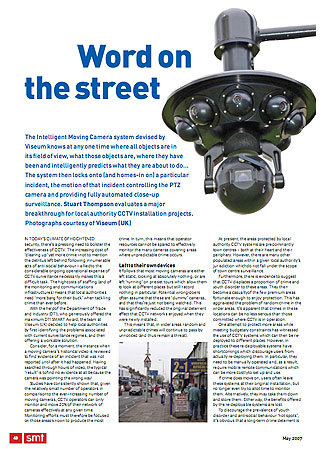 Security Management TodayMay 2007“Word on the street”, with the council trial report
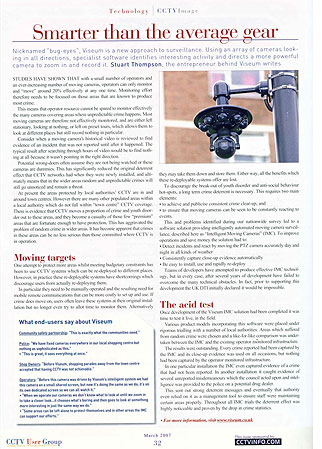 CCTV ImageMarch 2007“Smarter than the average gear”
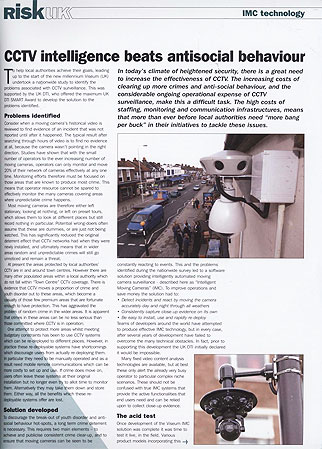 Risk UKMarch 2007“CCTV intelligence beats antisocial behaviour”
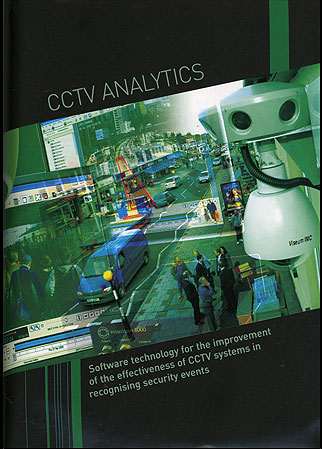 Risk UKAugust 2007“CCTV analytics”
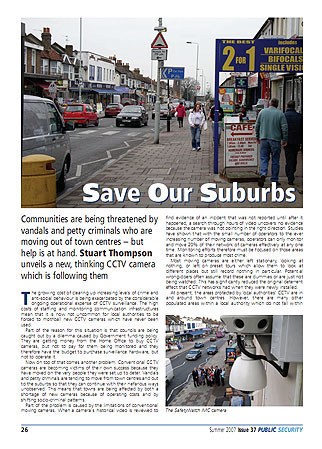 Public SecuritySummer 2007“Save Our Suburbs”
The record
- European patentEP1579399B1, Surveillance device, granted 25 July 2007. European Patent Office record, via Google Patents.
- United States patentUS7952608B2, granted 31 May 2011. United States register, via Google Patents.
- Patent opinionUK Intellectual Property Office, Opinion 06/14, 14 May 2014, after a professional challenge: claims 1 and 9 are “both novel and inventive over the prior art raised by the requestor”. The published opinion.
He solves problems institutions call impossible. He has proved the maturity of his ideas by delivering transformative solutions at scale. Now he is working on the next big thing.